Dust gathers on cupboard tops, between shelves and behind radiators in very different spaces. A long duster does not automatically reach all of them well. The head shape and control over the handle matter too. List your home’s difficult areas before choosing a set that contains several similar attachments for imagined future tasks.
Measure the gap behind the furniture
For narrow spaces, consider the head’s thickness including its support. A soft cover can look flat while concealing a hard frame. Check whether you can guide the tool in and out without forcing it. Do not move furniture casually just to make an unsuitable attachment usable.
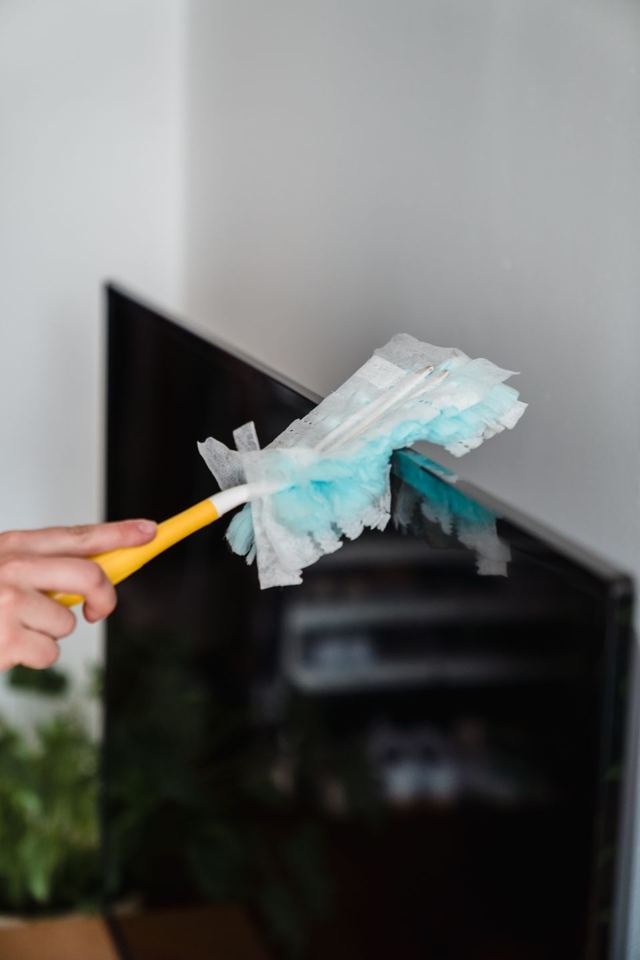
A high cupboard top needs a different shape from the spaces between books. An adjustable-angle head may help, but it still needs to remain controllable in that position. Inspect exposed edges and screws as well. Treat delicate surfaces and objects only with a method explicitly suitable for them.
Reach without awkward movements
Compare usable handle length with the place where you can stand. A fully extended handle may behave differently from a short one. Check that its locking mechanism is easy to use and holds securely. Extra reach should not encourage leaning far over furniture or standing on an unsuitable chair.
Do not put a duster into running equipment or electrical parts for which that cleaning method is not intended. Follow the individual instructions for lamps, ventilation appliances and radiators. A long attachment is not general permission to clean concealed or delicate areas without further checks.
Clean the head after the job
Before buying, find out how collected dust is removed. Some heads detach and can be washed, while others need different care. Read the exact instructions, including drying and refitting. A tool with a head that is difficult to clean can soon become inconvenient for frequent jobs.
Store the duster without leaving its shape permanently compressed. If you need several attachments, give each a recognisable job. A small, suitable selection is often enough: perhaps a flat head for gaps or an appropriate head for cupboard tops. Add another only when an actual area remains inaccessible.
Before you buy
- Measure narrow gaps and the necessary reach.
- Look for hard supports beneath soft fibres.
- Check handle locks and control over the head.
- Read cleaning, drying and storage instructions.
The right duster reaches the intended location with control and can be maintained afterwards. Maximum length alone does not solve the task.