Drawer dividers promise order, but they can also create unusable gaps and compartments that are too narrow. Before buying, test a possible arrangement with the contents you already own. The best layout keeps frequently used things within comfortable reach and lets the drawer close without pushing items back down.
Measure the usable interior
Measure the inside rather than the drawer front. Allow for rounded corners, screws and side fittings. Height matters too. An organiser may be shallow enough on its own, while a large ladle placed inside catches on the surface above.
Compare measurements at the front and back, especially in older furniture. If an adjustable divider relies on tension, its construction must suit the drawer. Pressure on delicate side panels is a poor substitute for the correct size. Read the installation guidance before extending an insert to its maximum width.
Recreate the common movements
Group the contents on a table by task. Cutlery, small kitchen tools and occasional items do not all need identical compartments. Put frequently used objects towards the front and check that there is room for your hand beside them.
Cut paper strips to represent possible compartments. This lets you test whether a long turner, a tin opener or several rolled textiles will really fit. A compartment that looks organised only when empty offers little help when its contents vary during the week.
Balance flexibility with extra edges
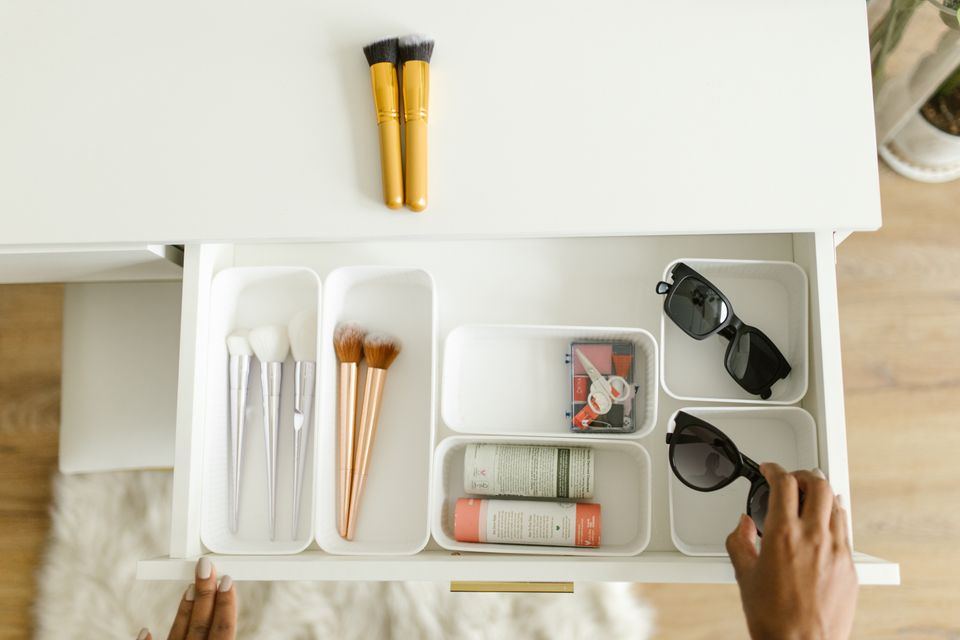
Small individual boxes can be rearranged easily but may slide as the drawer opens. A single insert often stays more stable, although it is more closely tied to a particular drawer. Check how the chosen system resists movement without unnecessarily damaging the surface underneath.
Numerous partitions create more places for crumbs and dust than a few larger sections. Smooth, accessible corners simplify cleaning. Try removing the organiser before filling it completely. If every small item must first be taken out individually, that effort belongs in the buying decision too.
Before you buy
- Measure the interior in several places.
- Check height with the actual contents included.
- Try compartment sizes using paper strips.
- Place frequently used objects towards the front.
- Consider sliding and future cleaning.
Plan compartments for the objects and the movements involved. An evenly divided drawer is useful only when the arrangement works while full.