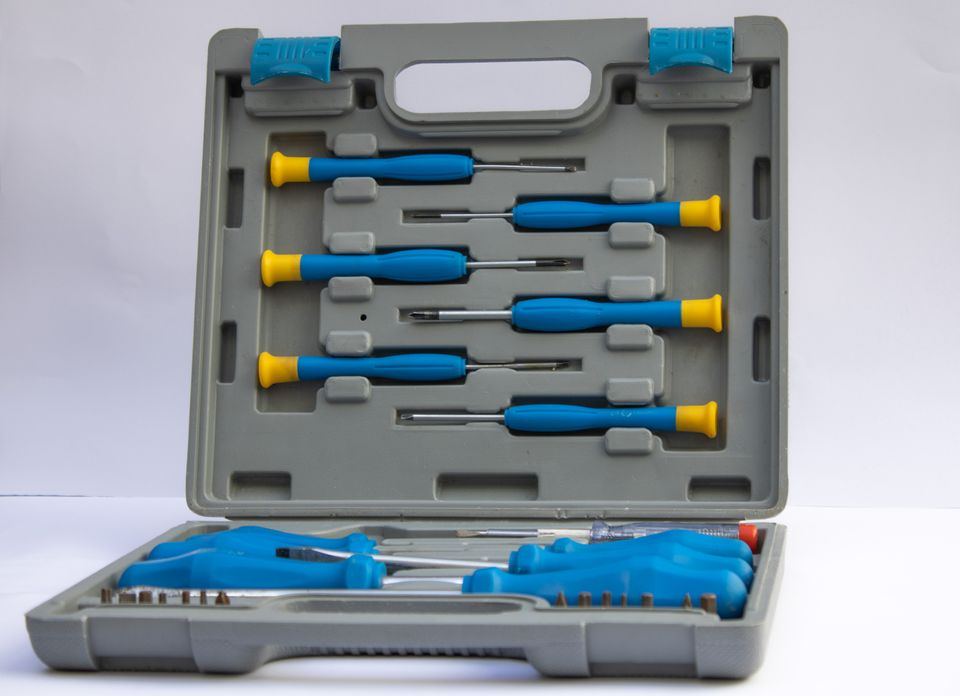
A large toolbox is not automatically the best starting point. Tightening a furniture handle or following a small assembly task requires suitable tools you can control. Begin with jobs you can perform safely yourself. Work on electrical appliances, gas or water installations falls outside this simple kit for occasional household tasks.
Look at existing screws
Check furniture or supplied assembly instructions to identify the screw heads involved. A suitable screwdriver should sit securely in the head. Different cross-head profiles are not simply interchangeable. If you are unsure, photograph the screw and ask a specialist retailer for a matching tool.
A handle with interchangeable bits can save space. It helps only when the required bits are easy to fit and there is enough room for the handle at the work position. A long bit holder may be awkward behind a small furniture handle.
Add measuring and gripping tools selectively
A tape measure and a plain pencil are useful for many small jobs. Pliers make sense only when their shape suits the intended task. Do not buy them merely because a set advertises a certain number of tools.
Look for comfortable handles and clear markings. Try the handling where a shop allows it. The largest or heaviest tool is not automatically better for a small screw. Controlled work matters more than impressive dimensions.
Compare a toolbox honestly
When assessing a set, mentally separate the main tools from the many small inserts. Ask whether the sizes you need are included and whether worn or lost pieces can be replenished individually. Duplicate bits can be useful, but they also increase the piece count.
Buying tools separately allows a more precise selection. A small set may be convenient when you actually use its contents. Compare it with your task list and existing tools rather than an abstract ideal of a completely equipped household.
Define the job and its limits
Read the instructions before assembly and lay out the specified fittings. Stop if material is damaged, a connection does not hold or unexpectedly high force seems necessary. Drilling into unfamiliar walls and working on installations require separate informed planning. Store tools dry, organised and out of children’s reach. A modest collection stays complete more easily when every tool has a fixed place.
Before you buy
- Identify the tasks and screw types first.
- Match tools to confined working spaces.
- Compare set contents with real needs.
- Seek informed help for unclear fixings.
A useful starter kit suits simple, clearly defined tasks. It grows selectively with your needs and experience.